£125.00
Film
Dracula: Prince of Darkness
1966
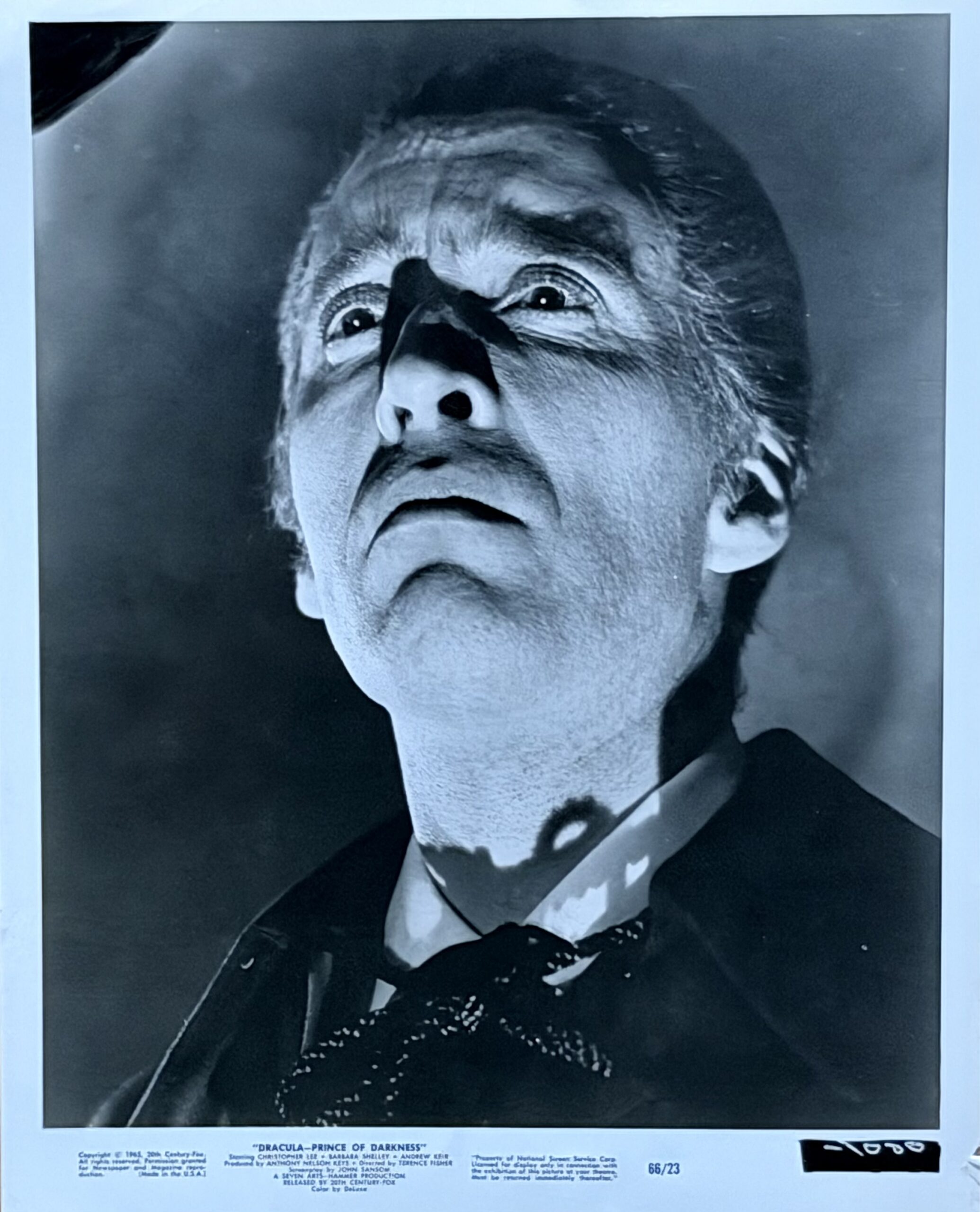
10″ x 8″ Black & White Promotional Still
United States (USA)
Very Fine minus to Very Fine – Single Sided – Flat/Unfolded (as issued)
Terence Fisher
Andrew Keir, Christopher Lee, Peter Cushing, Barbara Shelley, Charles 'Bud' Tingwell, Francis Matthews, Philip Latham, Suzan Farmer, Thorley Walters
SOLD - this item is sold. Please browse our currently available stock
“DEAD for Ten Years DRACULA, Prince of Darkness, LIVES AGAIN!”
Christopher Lee’s commanding presence dominates this striking original 1966 US black-and-white publicity still for “Dracula: Prince of Darkness”. One of the BEST Dracula images from any of the Hammer series. Photographed from a low angle, his upward gaze and dramatically lit features convey the aristocratic menace that made his portrayal of Count Dracula so memorable. The tightly framed composition gives this iconic image an imposing quality, with deep shadows emphasising Lee’s unmistakable features.
Directed by Terence Fisher, the film marked Lee’s return to the role following Hammer’s “Dracula” (1958). Set around four travellers whose arrival at an isolated castle leads to the Count’s resurrection, it combines Gothic atmosphere with Lee’s formidable, wordless performance.
Presented in very fine original condition, this United States publicity still retains its printed film identification and distribution details in the lower border, together with the National Screen Service reference number 66/23. A compelling display piece for collectors of Christopher Lee, Hammer horror and classic cinematic portraiture.
Trivia: In the scene where Dracula is being “resurrected” from a coffin into which his ashes have been spread, from blood dripping down from a poor victim (provided by Klove) Dracula is made to “manifest himself” over a period of about a minute. This was achieved by overlapping “dissolves” of a series of twelve locked-down camera shots, involving first the ashes, then a skeleton, then some body-fat on the skeleton, et cetera, along with swirling mist, until we finally perceive the full form of Dracula. He doesn’t appear fully dressed as is usually the case. The shot moves to outside the coffin and a bare arm reaches out. The vampire’s clothes were seen in earlier scenes awaiting his return.
…more detailVintage Movie Posters Grading Criteria... read more +
Dracula: Prince of Darkness Movie Poster
“Two couples traveling in eastern Europe decide to visit Karlsbad despite dire local warnings. Left outside the village by a coachman terrified at the approach of night, they find themselves in the local castle and are surprised at the hospitality extended by the sinister Klove. It turns out the owner, Count Dracula, dead for ten years, has been hoping for such a visit.”
You know the song and dance: people are warned not to go up to that darn castle! British travelers are going through the countryside, and they hear about this castle up on a hill. They’re told not to go there – why, exactly, maybe it’s not entirely clear as “His” name is not invoked. But, alas, they do go there, and after being welcomed in an eerie way (everything at the table is all set up for them, and they’re served by a sorta creepy butler), they stick around. Needless to say, after a ritual that involves a LOT of blood from a man hung upside down, Count Dracula rises from his grave – or, I should say reforms out of like the dirt and blood and ash and whatnot. Take it away, Christopher Lee, with your seductive-monstrous self!
Hammer horror here, and it’s fun. “Dracula: Prince of Darkness” was the first sequel to (Horror of) “Dracula”, the film that first brought Lee to Hammer’s world of Bram Stoker, and made him iconic for millions across the world. This time he doesn’t have a word of dialog – whether this was by design of the script or Lee being a (rightful) primadonna and ordering cuts, who can say, legend-fact-print-legend sort of thing – but no matter. He’s still creepy and in his pacing of taking his time to reach his victims terrifying (geuinely so, there’s no cheese here, not a shred). And in his way he’s also kind of seductive… yes, even with those red eyes.
The rest of the movie around Lee and his assistant is alright. Barbara Shelley makes for a good female foil and is beautiful. And the sets and music are spot on. Perhaps it’s worth noting that characterisation for the humans isn’t that strong, but then is it necessary? The beats are here – the crosses, the Van Helsing (Peter Cushing) who knows all and leads the hunt against the Prince of Darkness – and it’s hard to feel much suspense in the climax when you know how it’s going to go down. But it’s still classy filmmaking from Terence Fisher and it’s refreshing to see a horror movie that takes its time, gives characters and sets room to breathe in shots, and you’ll want to keep watching for when the Count appears.

Trade Address:
Vintage Movie Posters (UK) Limited
The Malthouse
The Broadway
Old Amersham
HP7 0HL


© 2026 Vintage Movie Posters
Registered Office Address: Vintage Movie Posters (UK) Limited, Aston House, Cornwall Avenue, London N3 1LF GB
Registered Company No: 07664517
Mint
A poster that has never been used or displayed and may show the most minor signs of age and wear. The poster should have no holes or tears.
Near Mint
A generally unused poster with fresh, saturated colors. May have minimal tears at folds. Has no significant holes, no paper loss, may have minor tears along edges, may have fine pin holes.
Very Fine
A poster with bright colour and crisp overall appearance. It may have very general signs of use including slight fold separation and fold wear. It may have pin holes or very minor tears. This is the highest grade allowed for a poster that has been restored either on linen or on paper.
Fine
A poster with good colors and overall clean appearance. It may have minor tears small paper loss and minor stains. It may have some fold seperation.
Good
An average poster with overall fresh color. May have tears, minor paper loss, minor hazing. Paper may be brittle due to age, may have minor stains. May have a small amount of writing in an unobtrusive place. May have medium or major restoration.
Fair
A poster with faded colors and brittle paper, showing significant signs of use. May have tears and paper loss. May have tape, writing, stains in image area. In need of restoration or had major restoration.
Poor
A poster that is worn, torn, and/or damaged. May have staining, cracking, dry rot, and/or large tears. May be heavily soiled, may have pieces missing. In need of major restoration.
All photographs and images used on our site are photographs of the actual poster/item you are buying, we do not use stock photographs.
LOBBY CARD
11 x 14″ printed on heavy stock paper. Used as display in theatre lobbies. Originally made in sets of eight. Some sets have a title card, which contains credits and artwork, essentially a mini-poster. The remaining seven cards are coloured photographic credits and poster artwork showing different scenes from the movie.
WINDOW CARD
14 x 22″ printed on heavy stock paper with the top 4-6 inches usually left blank for the local cinema owner to fill in the cinema and the date it was due to play. Largely discontinued during the 1970’s.
HALF SHEET
22 x 28″ printed on heavy stock paper. The image displayed is normally a smaller version of the main poster, although some do have different artworks and sometimes come in two versions.
INSERT
14 x 36″ printed on heavy stock paper. Inserts usually have the same artwork as a one sheet. Popular with collectors since they are smaller and easier to frame. Normally come tri folded or rolled.
STYLE Y/FORTY BY SIXTY
40 x 60″ printed on heavy stock paper. Rare since they were primarily used for major motion pictures only. Designed to be used outside the theatre, on an easel, normally at a drive-in movie theatre.
ONE-SHEET
27 x 41″ printed on paper. This is the most common size of poster, intended to be displayed in a glass “marquee” case. It is the most sought after size by collectors. Since the 1980’s most posters are sent to the theatre rolled and maybe slightly smaller measuring 27″ by 40″ and with the advent of backlit light boxes a growing number of modern movie posters are available double-sided and the more traditional single-sided.
THREE-SHEET
41 x 81″ printed on paper. These were printed on two or three separate sheets designed to overlap, few survive. Used for larger advertising spaces, normally posted on walls, perfect for huge movie theatres the drive-in, where people could see them from a distance. From the 1970’s on, three-sheets were sometimes printed in one piece and issued as “international” versions to be used abroad.
BRITISH QUAD
30 x 40″ Most common poster size used in the UK. British Quads are horizontal and may have different artwork to the US one sheet. Like a US one sheet they normally come in two versions. Like a US one sheet they are usually supplied single-sided or more commonly now as a double sided poster.
BRITISH ONE-SHEET
27 X 40″, printed on paper. Very rarely used size.
ITALIAN LOCANDINA
13 x 28″ six inches shorter than the US insert, very nice size to frame. Italian poster illustrators are some of the best in the industry.
ITALIAN PHOTOBUSTA
18 x 26″ Glossy, high quality, used as lobby cards in Italy. Size may vary, either vertical or horizontal format. There are also double Photobusta or mini Photobusta.
2-FOGLIO (DUE)
(DUE): 39 x 55″ This is the standard poster size used in Italy. Italian poster illustrators are some of the best in the industry.
4-FOGLIO
(QUATTRO) 55 x 79″ Very large Italian poster printed in two pieces, often contains very beautiful artwork.
FRENCH
47 x 63″ (GRANDE) or 24 x 33″ (PETITE) French movie posters normally come with different artwork to either the US or the UK. Like the Italian’s some of the artwork is extrememly beautiful.