£195.00
Film
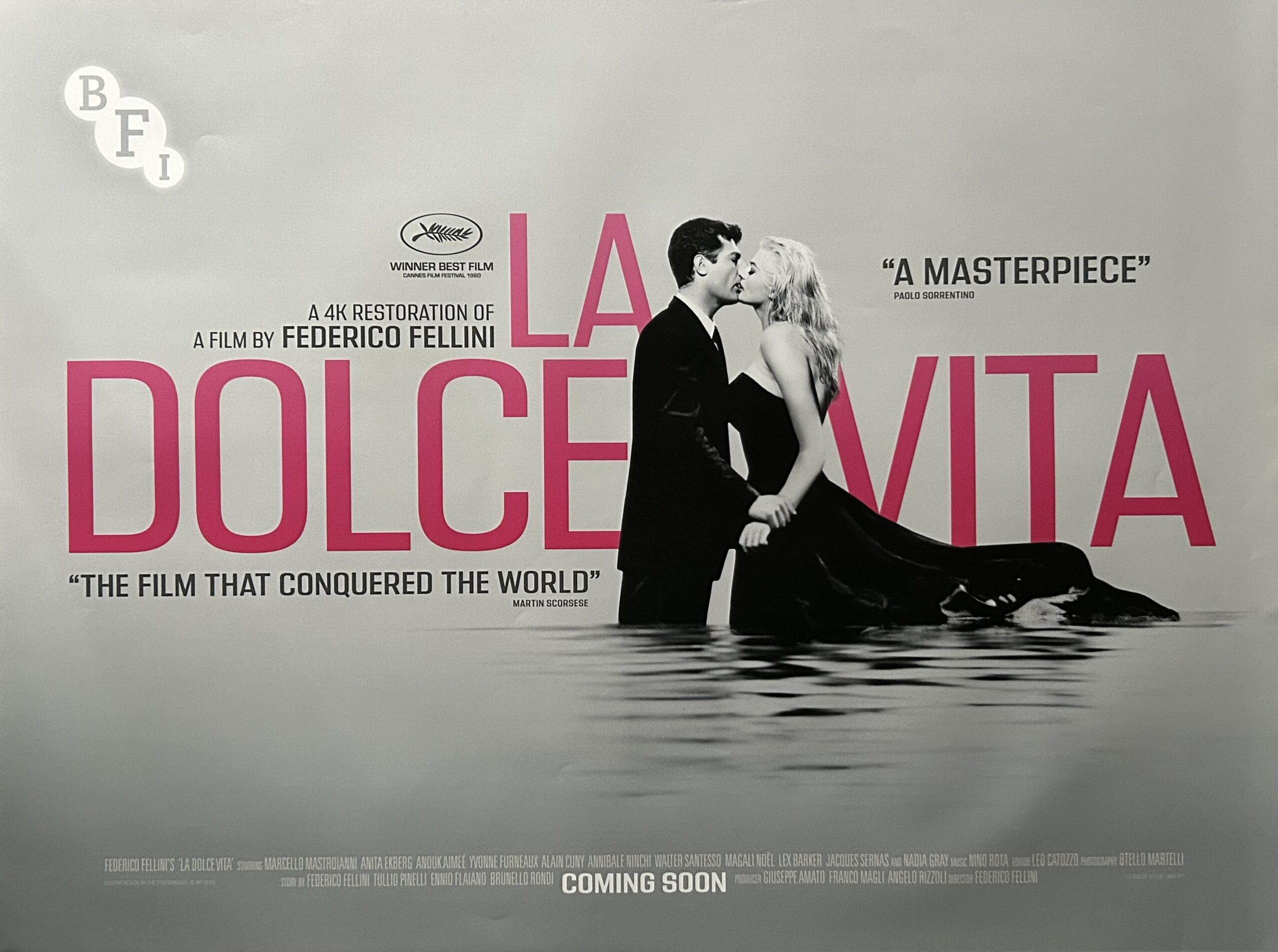
La Dolce Vita
1954, 2021 BFI Release
UK Quad (30" x 40") Single Sided
UK / British
Near mint minus; originally rolled (as issued)
Akira Kurosawa
Daisuke Katô, Kamatari Fujiwara, Keiko Tsushima, Yukiko Shimazaki, Takashi Shimura, Toshiro Mifune
SOLD - this item is sold. Please browse our currently available stock
One of the best and most acclaimed movie ever made, Federico Fellini’s “La Dolce Vita”. A stunning, duotone photographic film poster, featuring the titular ‘La Dolce Vita’ exclusive to the remastered BFI release of 2020 with imagery that is unique to Britain and only featured on this UK quad poster that features the iconic scene of Anita Ekberg ebulliently splashing her way into the centre of the Trevi Fountain in Rome. The example offered here is presented in excellent unrestored, rolled (as issued) condition. It displays beautifully. As a largely art-house and independent cinema release, posters for this limited time screening are extremely scarce and rarely comes to market. It represents a fine piece of collectable movie memorabilia for one of the big screen’s greatest & most influential films.
Trivia: The film contributed the term “paparazzo” to the language. The term derives from Marcello’s photographer friend Paparazzo. Federico Fellini took the name “Paparazzo”, as he explained in a later interview, from the name of someone he met in Calabria (Southern Italy) where Greek names are still common. “Paparazzi” is the plural.
…more detailVintage Movie Posters Grading Criteria... read more +
In many ways, “La Dolce Vita” has to be regarded as the defining film of its era. It presaged a new style of cinema. It had a fluid, dreamy, symbolic visual and narrative form, and its resonance stems from its visual set pieces and overall ambience. It is also a fascinating exploration of the lifestyles and attitudes of an incipient, flash, indulgent and directionless generation.
The film is mainly remembered for the iconic scene of Anita Ekberg ebulliently splashing her way into the centre of the Trevi Fountain, followed by an adoring Marcello Mastroianni The scene is emblematic of the film in the sense that it represents characters who wish to break free from the constraints of previous generations but their efforts, while perhaps on the surface appearing daring and romantic, often lead to nowhere. There’s a sense of searching but not finding: breaking free of one set of constraints only in order to meet another. Marcello, the film’s protagonist and perhaps a representation of the director himself, wants to be free of his wife and he doesn’t want to sell himself to the capitalist system, but what else is there to provide meaning to his life? He is failing as an artist and his romantic conquests seem empty and unfulfilling. He yearns for a time when life was more clearly defined and yet he loathes the responsibility and entrapment that that definition would impose. And so he drifts from party to party, a little less energetic, a little more cynical on each occasion.
“La Dolce Vita” shows us the new hedonism and society’s burgeoning obsession with celebrity. It is responsible for the word “paparazzi”, which came from the name of one of the supporting characters, and it features a very young Nico, who would go on to achieve fame with one of the defining bands of the ’60s. The film is a bold and brilliant exploration of life as it was lived by the upper-classes and the emerging chattering classes of the time. It’s an enthralling experience which is both sweet and sombre.

Trade Address:
Vintage Movie Posters (UK) Limited
The Malthouse
The Broadway
Old Amersham
HP7 0HL


© 2026 Vintage Movie Posters
Registered Office Address: Vintage Movie Posters (UK) Limited, Aston House, Cornwall Avenue, London N3 1LF GB
Registered Company No: 07664517
Mint
A poster that has never been used or displayed and may show the most minor signs of age and wear. The poster should have no holes or tears.
Near Mint
A generally unused poster with fresh, saturated colors. May have minimal tears at folds. Has no significant holes, no paper loss, may have minor tears along edges, may have fine pin holes.
Very Fine
A poster with bright colour and crisp overall appearance. It may have very general signs of use including slight fold separation and fold wear. It may have pin holes or very minor tears. This is the highest grade allowed for a poster that has been restored either on linen or on paper.
Fine
A poster with good colors and overall clean appearance. It may have minor tears small paper loss and minor stains. It may have some fold seperation.
Good
An average poster with overall fresh color. May have tears, minor paper loss, minor hazing. Paper may be brittle due to age, may have minor stains. May have a small amount of writing in an unobtrusive place. May have medium or major restoration.
Fair
A poster with faded colors and brittle paper, showing significant signs of use. May have tears and paper loss. May have tape, writing, stains in image area. In need of restoration or had major restoration.
Poor
A poster that is worn, torn, and/or damaged. May have staining, cracking, dry rot, and/or large tears. May be heavily soiled, may have pieces missing. In need of major restoration.
All photographs and images used on our site are photographs of the actual poster/item you are buying, we do not use stock photographs.
LOBBY CARD
11 x 14″ printed on heavy stock paper. Used as display in theatre lobbies. Originally made in sets of eight. Some sets have a title card, which contains credits and artwork, essentially a mini-poster. The remaining seven cards are coloured photographic credits and poster artwork showing different scenes from the movie.
WINDOW CARD
14 x 22″ printed on heavy stock paper with the top 4-6 inches usually left blank for the local cinema owner to fill in the cinema and the date it was due to play. Largely discontinued during the 1970’s.
HALF SHEET
22 x 28″ printed on heavy stock paper. The image displayed is normally a smaller version of the main poster, although some do have different artworks and sometimes come in two versions.
INSERT
14 x 36″ printed on heavy stock paper. Inserts usually have the same artwork as a one sheet. Popular with collectors since they are smaller and easier to frame. Normally come tri folded or rolled.
STYLE Y/FORTY BY SIXTY
40 x 60″ printed on heavy stock paper. Rare since they were primarily used for major motion pictures only. Designed to be used outside the theatre, on an easel, normally at a drive-in movie theatre.
ONE-SHEET
27 x 41″ printed on paper. This is the most common size of poster, intended to be displayed in a glass “marquee” case. It is the most sought after size by collectors. Since the 1980’s most posters are sent to the theatre rolled and maybe slightly smaller measuring 27″ by 40″ and with the advent of backlit light boxes a growing number of modern movie posters are available double-sided and the more traditional single-sided.
THREE-SHEET
41 x 81″ printed on paper. These were printed on two or three separate sheets designed to overlap, few survive. Used for larger advertising spaces, normally posted on walls, perfect for huge movie theatres the drive-in, where people could see them from a distance. From the 1970’s on, three-sheets were sometimes printed in one piece and issued as “international” versions to be used abroad.
BRITISH QUAD
30 x 40″ Most common poster size used in the UK. British Quads are horizontal and may have different artwork to the US one sheet. Like a US one sheet they normally come in two versions. Like a US one sheet they are usually supplied single-sided or more commonly now as a double sided poster.
BRITISH ONE-SHEET
27 X 40″, printed on paper. Very rarely used size.
ITALIAN LOCANDINA
13 x 28″ six inches shorter than the US insert, very nice size to frame. Italian poster illustrators are some of the best in the industry.
ITALIAN PHOTOBUSTA
18 x 26″ Glossy, high quality, used as lobby cards in Italy. Size may vary, either vertical or horizontal format. There are also double Photobusta or mini Photobusta.
2-FOGLIO (DUE)
(DUE): 39 x 55″ This is the standard poster size used in Italy. Italian poster illustrators are some of the best in the industry.
4-FOGLIO
(QUATTRO) 55 x 79″ Very large Italian poster printed in two pieces, often contains very beautiful artwork.
FRENCH
47 x 63″ (GRANDE) or 24 x 33″ (PETITE) French movie posters normally come with different artwork to either the US or the UK. Like the Italian’s some of the artwork is extrememly beautiful.