£3,995.00
Film
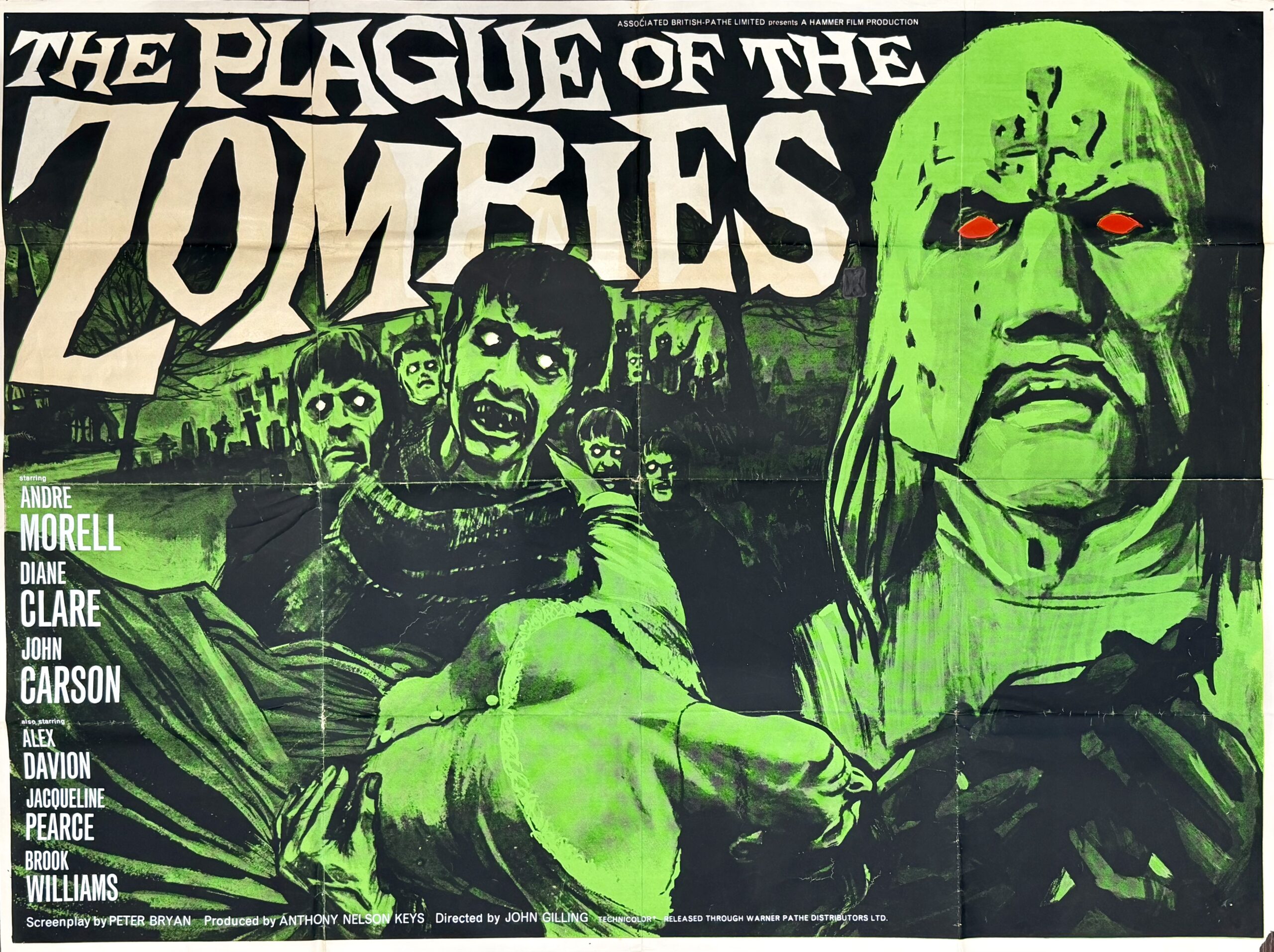
Plague of the Zombies, The
1966
UK Quad (30" x 40") Single Sided
UK / British
Very Good plus – Originally Folded (as issued), X certificate has been blacked out
John Gilling
Alexander Davion, Andre Morell, Brook Williams, Diane Clare, Jacqueline Pearce, John Carson, Marcus Hammond, Michael Ripper
SOLD - this item is sold. Please browse our currently available stock
“Doomed To Walk The Earth As Slaves To The Lord Of The Living Dead!!!”
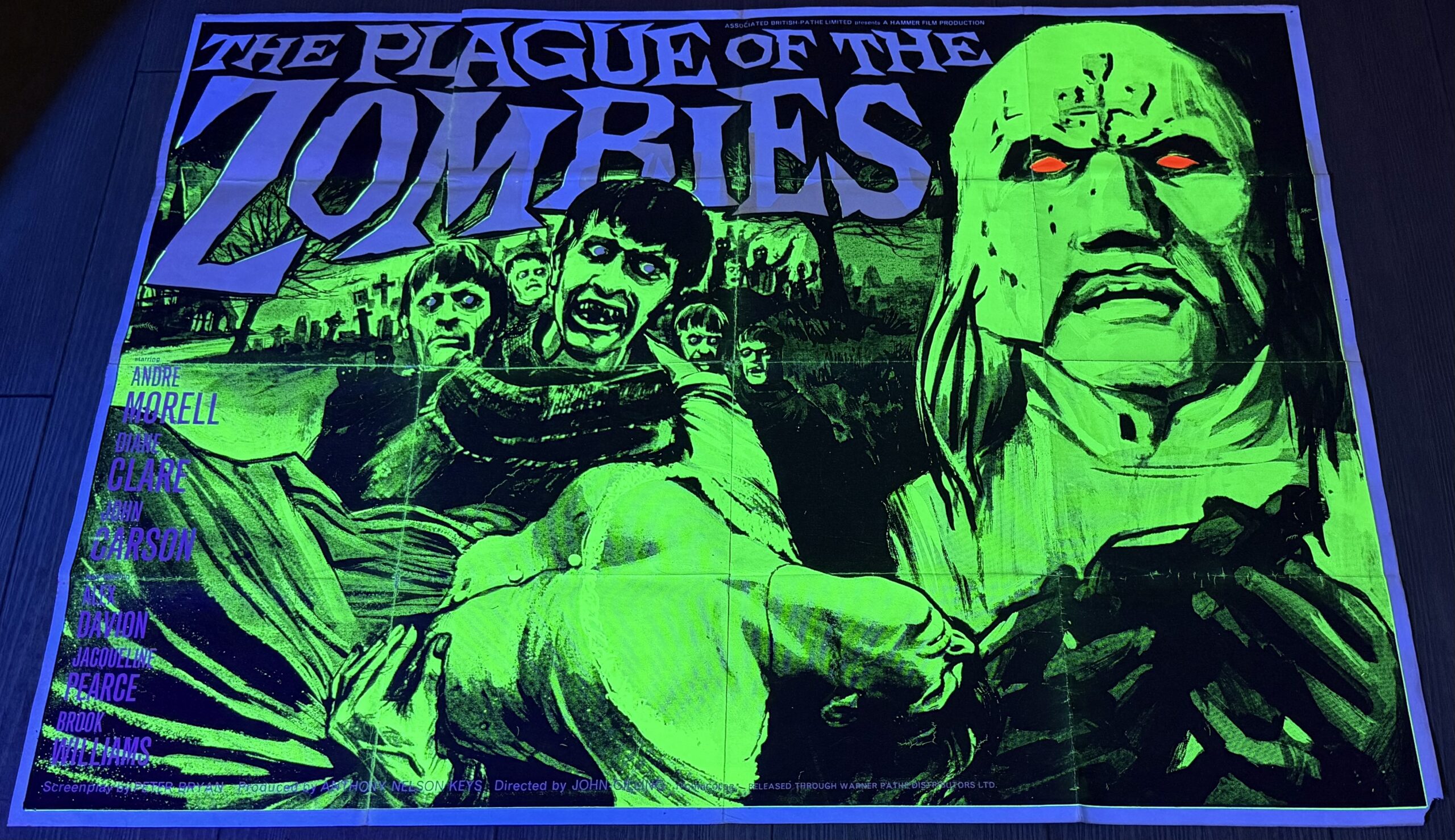
“The Plague Of The Zombies” is easily one of Hammer’s finest efforts and essential viewing for fans of the living dead. The talented cast give some excellent performances (Andre Morell, in particular, is great as the open-minded man of science who is quite prepared to embrace the notion of witchcraft), whilst director John Gilling ensures that the film rattles along at a fair pace, managing some pretty chilling set-pieces in the process: a creepy dream-sequence that sets the standards for corpses crawling from their graves; a shocking scene in which we meet our first walking dead; and a truly memorable moment that features the decapitation of a zombie by spade (come to think of it, maybe Sam Raimi also owes a little of his success to this film). Originally released in a double bill presentation with “Dracula, Prince of Darkness” the standalone British UK quad that accompanied the film’s release in 1966 was only used in a small number of provincial cinemas. It is certainly impressive and one of the hardest (if not the hardest) to find from the House of Horror with a genuine scarcity that appeals to serious Hammer collectors and horror fans. Extremely innovative for the time the use of glow in the dark inks (see supplementary photograph) transforms (under a blacklight) an impressive horror poster into something very spooky indeed. The zombie imagery, much like the film is particularly creepy. Offered folded (as issued) this original unrestored example presents very well, but does show signs of age and handling wear with the X- certificate rating blacked out. Not just incredibly scarce, this was Hammer’s only foray into the zombie genre, a full two years before George A. Romero came to prominence with a certain “Night of the Living Dead” and represents one of THE Hammer posters own.
Trivia: Before allowing the film to be released, the B.B.F.C instructed “Hammer” to trim one or two scenes. Amongst them, the scene where Andre Morell decapitates the zombie in the graveyard with a shovel had to be reduced from showing four blows with the weapon to just the one.
…more detail
Vintage Movie Posters Grading Criteria... read more +
“Young workers are dying because of a mysterious epidemic in a little village in Cornwall. Doctor Tompson is helpless and asks professor James Forbes for help, and the professor and his daughter Sylvia travel to Tompson. Soon terrible things happen, beyond imagination or reality. Dead people are seen near an old, unused mine; recently-deceased people seem to have come back to life. Professor Forbes presumes that black magic is involved and someone has extraordinary power. He doesn’t know how close he is: the dead become alive because of a magic voodoo ritual, so they must serve their master as mindless zombies.”
Sir James Forbes (André Morell) and his daughter, Sylvia (Diane Clare), are out of the blue requested to travel to a Cornish village by Sir James’ former pupil, Dr. Peter Thompson (Brook Williams). The village has become a haven for mysterious deaths and Peter’s believes that Sir James can shed some light on the matter. No sooner do they arrive when another victim surfaces and it’s quickly becomes evident that something far more sinister than medical problems is at work here.
Hammer Horror tackles the zombie sub-genre with no little amount of success. Directed by John Gilling, “The Plague Of The Zombies” was filmed back to back with the equally entertaining “The Reptile“. Filmed out of fortress Hammer that was Bray Studios, the same sets that were used for “The Reptile“ were also used here. With Bernard Robinson’s Cornish Village again a treat for sore eyes. 1966 was the last year that Hammer used Bray Studios and it’s fitting that it was a year that saw efficient and varying creepers filling out the Hammer Horror cannon. Peter Bryan‘s story, aided by some interesting imagery, delves into the dark world of witchcraft and voodoo, thus giving this particular “zombie” piece an extra dimension. This is not merely about zombies roaming the countryside and killing indiscriminately. Evil they are of course, but they have a purpose and being that comes to light as the story unfolds. There’s also nods to tyranny and exploitation, wryly observed by the makers here, cheekily cloaked in a cloud of rotting flesh.
Technically it holds up rather well too. The effects are strong enough to carry the story, with the zombies eerie personified as they shuffle around all green flesh and grumbling away as we know they should. All captured in deluxe colour that comes out nice in High Definition. The cast are fine, with Morell standing out as he gives his usual classy and professional performance, while James Bernard’s score is suitably at one with each and every change of pace. This is not just a fine and under appreciated part of the Hammer Horror output, it’s also a worthy and most notable entry in the “zombie” genre.

Trade Address:
Vintage Movie Posters (UK) Limited
The Malthouse
The Broadway
Old Amersham
HP7 0HL


© 2026 Vintage Movie Posters
Registered Office Address: Vintage Movie Posters (UK) Limited, Aston House, Cornwall Avenue, London N3 1LF GB
Registered Company No: 07664517
Mint
A poster that has never been used or displayed and may show the most minor signs of age and wear. The poster should have no holes or tears.
Near Mint
A generally unused poster with fresh, saturated colors. May have minimal tears at folds. Has no significant holes, no paper loss, may have minor tears along edges, may have fine pin holes.
Very Fine
A poster with bright colour and crisp overall appearance. It may have very general signs of use including slight fold separation and fold wear. It may have pin holes or very minor tears. This is the highest grade allowed for a poster that has been restored either on linen or on paper.
Fine
A poster with good colors and overall clean appearance. It may have minor tears small paper loss and minor stains. It may have some fold seperation.
Good
An average poster with overall fresh color. May have tears, minor paper loss, minor hazing. Paper may be brittle due to age, may have minor stains. May have a small amount of writing in an unobtrusive place. May have medium or major restoration.
Fair
A poster with faded colors and brittle paper, showing significant signs of use. May have tears and paper loss. May have tape, writing, stains in image area. In need of restoration or had major restoration.
Poor
A poster that is worn, torn, and/or damaged. May have staining, cracking, dry rot, and/or large tears. May be heavily soiled, may have pieces missing. In need of major restoration.
All photographs and images used on our site are photographs of the actual poster/item you are buying, we do not use stock photographs.
LOBBY CARD
11 x 14″ printed on heavy stock paper. Used as display in theatre lobbies. Originally made in sets of eight. Some sets have a title card, which contains credits and artwork, essentially a mini-poster. The remaining seven cards are coloured photographic credits and poster artwork showing different scenes from the movie.
WINDOW CARD
14 x 22″ printed on heavy stock paper with the top 4-6 inches usually left blank for the local cinema owner to fill in the cinema and the date it was due to play. Largely discontinued during the 1970’s.
HALF SHEET
22 x 28″ printed on heavy stock paper. The image displayed is normally a smaller version of the main poster, although some do have different artworks and sometimes come in two versions.
INSERT
14 x 36″ printed on heavy stock paper. Inserts usually have the same artwork as a one sheet. Popular with collectors since they are smaller and easier to frame. Normally come tri folded or rolled.
STYLE Y/FORTY BY SIXTY
40 x 60″ printed on heavy stock paper. Rare since they were primarily used for major motion pictures only. Designed to be used outside the theatre, on an easel, normally at a drive-in movie theatre.
ONE-SHEET
27 x 41″ printed on paper. This is the most common size of poster, intended to be displayed in a glass “marquee” case. It is the most sought after size by collectors. Since the 1980’s most posters are sent to the theatre rolled and maybe slightly smaller measuring 27″ by 40″ and with the advent of backlit light boxes a growing number of modern movie posters are available double-sided and the more traditional single-sided.
THREE-SHEET
41 x 81″ printed on paper. These were printed on two or three separate sheets designed to overlap, few survive. Used for larger advertising spaces, normally posted on walls, perfect for huge movie theatres the drive-in, where people could see them from a distance. From the 1970’s on, three-sheets were sometimes printed in one piece and issued as “international” versions to be used abroad.
BRITISH QUAD
30 x 40″ Most common poster size used in the UK. British Quads are horizontal and may have different artwork to the US one sheet. Like a US one sheet they normally come in two versions. Like a US one sheet they are usually supplied single-sided or more commonly now as a double sided poster.
BRITISH ONE-SHEET
27 X 40″, printed on paper. Very rarely used size.
ITALIAN LOCANDINA
13 x 28″ six inches shorter than the US insert, very nice size to frame. Italian poster illustrators are some of the best in the industry.
ITALIAN PHOTOBUSTA
18 x 26″ Glossy, high quality, used as lobby cards in Italy. Size may vary, either vertical or horizontal format. There are also double Photobusta or mini Photobusta.
2-FOGLIO (DUE)
(DUE): 39 x 55″ This is the standard poster size used in Italy. Italian poster illustrators are some of the best in the industry.
4-FOGLIO
(QUATTRO) 55 x 79″ Very large Italian poster printed in two pieces, often contains very beautiful artwork.
FRENCH
47 x 63″ (GRANDE) or 24 x 33″ (PETITE) French movie posters normally come with different artwork to either the US or the UK. Like the Italian’s some of the artwork is extrememly beautiful.