£75.00
Film
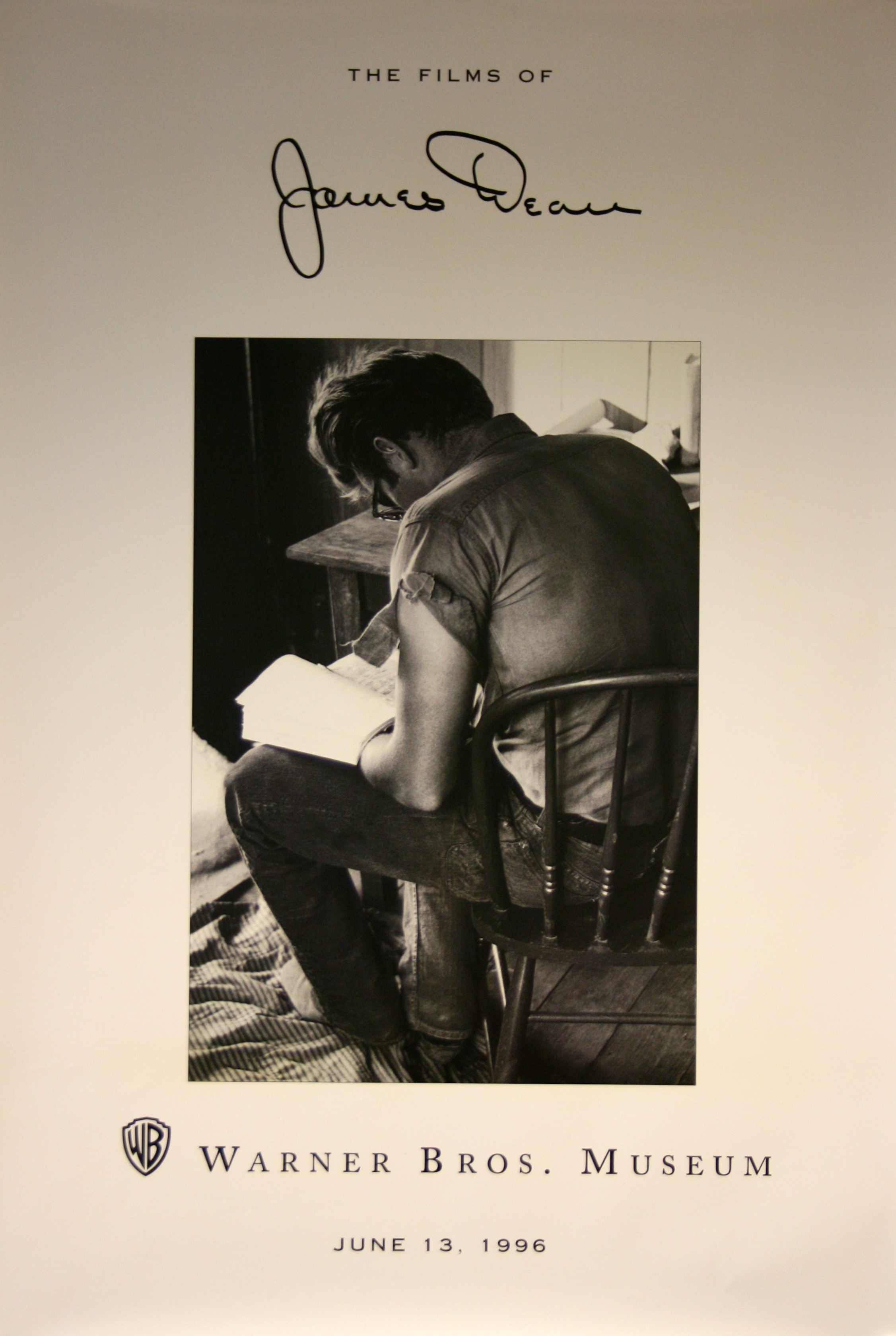
The Films of James Dean (1996)
1996
US One Sheet / single sided (27" x 40")
USA
Near Mint minus; originally rolled
Elia Kazan, George Stevens, Nicholas Ray
Elizabeth Taylor, James Dean, Julie Harris, Natalie Wood, Raymond Massey, Rock Hudson, Sal Mineo
SOLD - this item is sold. Please browse our currently available stock
For six months in 1996 the Warner Bros. Museum in Burbank, California presented a special cinematic exhibition featuring the three films the legendary movie star James Dean made for the Studio; East of Eden, Rebel Without a Cause and Giant. This beautiful US one sheet was produced for this event showing a lovely candid, unposed black and white shot of Dean relaxing reading a book…Printed on heavier than normal paper and originally rolled this looks fantastic and displays superbly….Due to a very limited print run (only made for display at the Museum) these examples are extremely scarce and sought after…Great imagery from one the screen’s true greats.
…more detailVintage Movie Posters Grading Criteria... read more +
James Dean was born in 1931 and raised on a farm by his aunt and uncle in Fairmount, Indiana. After grade school, he moved to New York to pursue his dream of acting. He received rave reviews for his work as the blackmailing Arab boy in the New York production of Gide’s “The Immoralist”, good enough to earn him a trip to Hollywood. His early film efforts were strictly bit parts: a sailor in the Dean Martin and Jerry Lewis overly frantic musical comedy Sailor Beware (1952); a GI in Samuel Fuller’s moody study of a platoon in the Korean War, Fixed Bayonets! (1951) and a youth in the Piper Laurie-Rock Hudson comedy Has Anybody Seen My Gal (1952)…He had major roles in only three movies. In the Elia Kazan production of John Steinbeck’s East of Eden (1955) he played Caleb, the “bad” brother who couldn’t force affection from his stiff-necked father. His true starring role, the one which fixed his image forever in American culture, was that of the brooding red-jacketed teenager Jim Stark in Nicholas Ray’s Rebel Without a Cause (1955). George Stevens’ filming of Edna Ferber’s Giant (1956), in which he played the non-conforming cowhand Jett Rink who strikes it rich when he discovers oil, was just coming to a close when Dean, driving his Porsche Spyder race car, collided with another car while on the road near Cholame, California on September 30, 1955. He had received a speeding ticket just two hours before. James Dean was killed almost immediately from the impact from a broken neck. He was 24. His very brief career, violent death and highly publicized funeral transformed him into a cult object of apparently timeless fascination.

Trade Address:
Vintage Movie Posters (UK) Limited
The Malthouse
The Broadway
Old Amersham
HP7 0HL


© 2026 Vintage Movie Posters
Registered Office Address: Vintage Movie Posters (UK) Limited, Aston House, Cornwall Avenue, London N3 1LF GB
Registered Company No: 07664517
Mint
A poster that has never been used or displayed and may show the most minor signs of age and wear. The poster should have no holes or tears.
Near Mint
A generally unused poster with fresh, saturated colors. May have minimal tears at folds. Has no significant holes, no paper loss, may have minor tears along edges, may have fine pin holes.
Very Fine
A poster with bright colour and crisp overall appearance. It may have very general signs of use including slight fold separation and fold wear. It may have pin holes or very minor tears. This is the highest grade allowed for a poster that has been restored either on linen or on paper.
Fine
A poster with good colors and overall clean appearance. It may have minor tears small paper loss and minor stains. It may have some fold seperation.
Good
An average poster with overall fresh color. May have tears, minor paper loss, minor hazing. Paper may be brittle due to age, may have minor stains. May have a small amount of writing in an unobtrusive place. May have medium or major restoration.
Fair
A poster with faded colors and brittle paper, showing significant signs of use. May have tears and paper loss. May have tape, writing, stains in image area. In need of restoration or had major restoration.
Poor
A poster that is worn, torn, and/or damaged. May have staining, cracking, dry rot, and/or large tears. May be heavily soiled, may have pieces missing. In need of major restoration.
All photographs and images used on our site are photographs of the actual poster/item you are buying, we do not use stock photographs.
LOBBY CARD
11 x 14″ printed on heavy stock paper. Used as display in theatre lobbies. Originally made in sets of eight. Some sets have a title card, which contains credits and artwork, essentially a mini-poster. The remaining seven cards are coloured photographic credits and poster artwork showing different scenes from the movie.
WINDOW CARD
14 x 22″ printed on heavy stock paper with the top 4-6 inches usually left blank for the local cinema owner to fill in the cinema and the date it was due to play. Largely discontinued during the 1970’s.
HALF SHEET
22 x 28″ printed on heavy stock paper. The image displayed is normally a smaller version of the main poster, although some do have different artworks and sometimes come in two versions.
INSERT
14 x 36″ printed on heavy stock paper. Inserts usually have the same artwork as a one sheet. Popular with collectors since they are smaller and easier to frame. Normally come tri folded or rolled.
STYLE Y/FORTY BY SIXTY
40 x 60″ printed on heavy stock paper. Rare since they were primarily used for major motion pictures only. Designed to be used outside the theatre, on an easel, normally at a drive-in movie theatre.
ONE-SHEET
27 x 41″ printed on paper. This is the most common size of poster, intended to be displayed in a glass “marquee” case. It is the most sought after size by collectors. Since the 1980’s most posters are sent to the theatre rolled and maybe slightly smaller measuring 27″ by 40″ and with the advent of backlit light boxes a growing number of modern movie posters are available double-sided and the more traditional single-sided.
THREE-SHEET
41 x 81″ printed on paper. These were printed on two or three separate sheets designed to overlap, few survive. Used for larger advertising spaces, normally posted on walls, perfect for huge movie theatres the drive-in, where people could see them from a distance. From the 1970’s on, three-sheets were sometimes printed in one piece and issued as “international” versions to be used abroad.
BRITISH QUAD
30 x 40″ Most common poster size used in the UK. British Quads are horizontal and may have different artwork to the US one sheet. Like a US one sheet they normally come in two versions. Like a US one sheet they are usually supplied single-sided or more commonly now as a double sided poster.
BRITISH ONE-SHEET
27 X 40″, printed on paper. Very rarely used size.
ITALIAN LOCANDINA
13 x 28″ six inches shorter than the US insert, very nice size to frame. Italian poster illustrators are some of the best in the industry.
ITALIAN PHOTOBUSTA
18 x 26″ Glossy, high quality, used as lobby cards in Italy. Size may vary, either vertical or horizontal format. There are also double Photobusta or mini Photobusta.
2-FOGLIO (DUE)
(DUE): 39 x 55″ This is the standard poster size used in Italy. Italian poster illustrators are some of the best in the industry.
4-FOGLIO
(QUATTRO) 55 x 79″ Very large Italian poster printed in two pieces, often contains very beautiful artwork.
FRENCH
47 x 63″ (GRANDE) or 24 x 33″ (PETITE) French movie posters normally come with different artwork to either the US or the UK. Like the Italian’s some of the artwork is extrememly beautiful.