£195.00
Film
Fear in The Night
1972
UK Quad (30" x 40") Single Sided
British / UK
Very Fine plus; originally folded (as issued)
Jimmy Sangster
Peter Cushing, Gillian Lind, Joan Collins, Judy Geeson, Ralph Bates
SOLD - this item is sold. Please browse our currently available stock
“School of Hammer…Do not expect blood, but do expect a stylish and engaging horror film.”
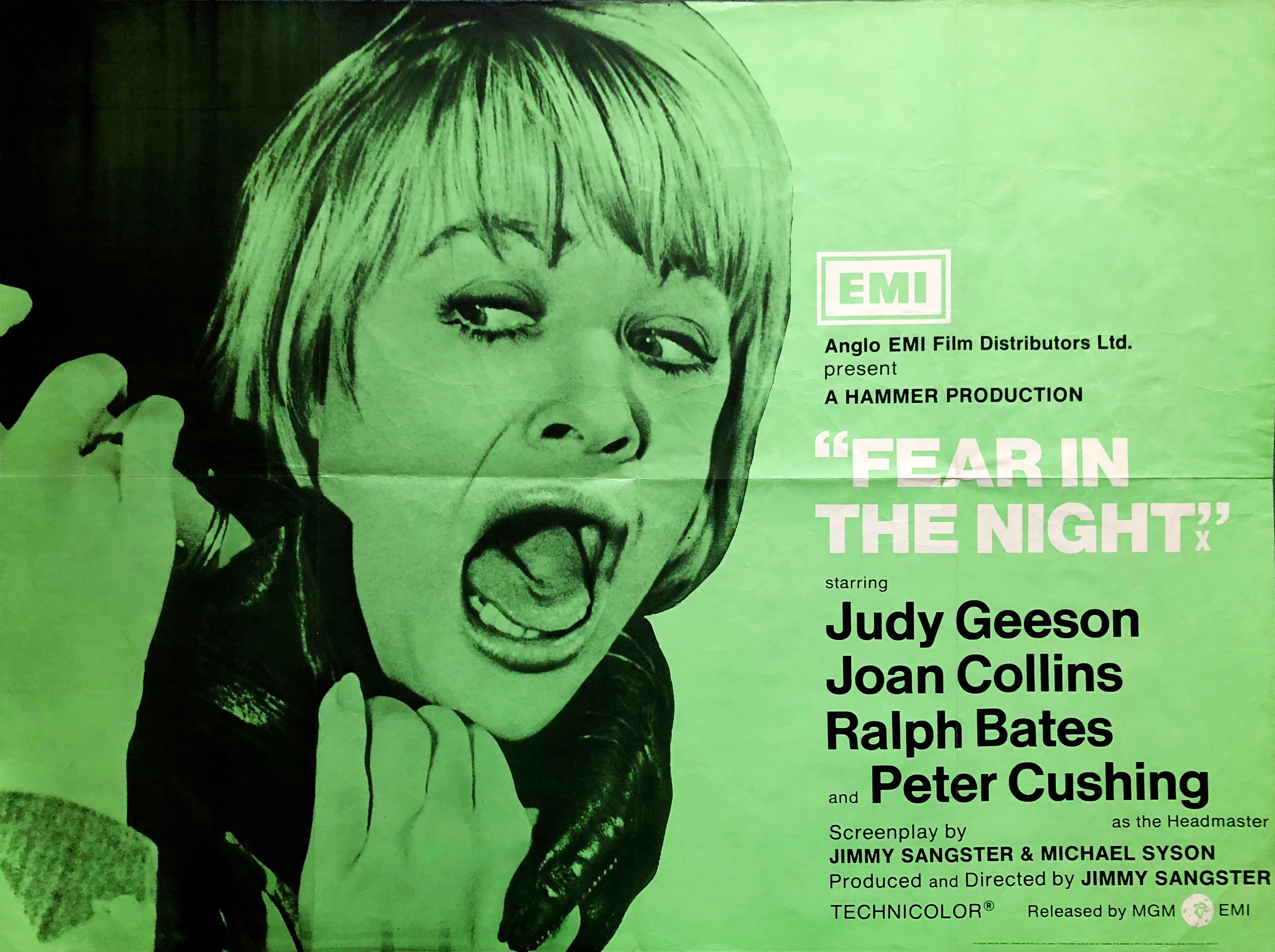
An under stated (when compared to other Hammer film posters) looking horror poster from the early 1970’s for Jimmy Sangster’s much under rated psychological horror thriller…“Fear in The Night”. This original British UK quad movie poster is from first year of release, 1972 and is a clever example of ‘less is more’ horror poster design as a screaming and clearly terrified Judy Geeson is being strangled by an unseen attacker. Very rare and hard to find in such excellent original unrestored condition; the green background is bright & unfaded with the blacks rich & deep. This scarce, folded (as issued) example displays and presents very well and represents an extremely collectable piece of 1970’s British horror cinema memorabilia.
TRIVIA: Peter Cushing and Ralph Bates both played Victor Frankenstein in the Hammer “Frankenstein” films
…more detailVintage Movie Posters Grading Criteria... read more +
Fear in The Night Movie Poster
“A young woman recovering from a nervous breakdown moves with her husband to a boys’ school, and finds herself being terrorized by a mysterious one-armed man, but nobody believes her.”
Although this is certainly not one of their more famous titles, I was actually quite impressed with “Fear in The Night“ which is an interesting variation on the famous French thriller “Diabolique” but with four main characters instead of three. Judy Geeson is a naive schoolmarm who marries a man (Ralph Bates) who she thinks is also a schoolteacher but actually turns out to be the caretaker of an abandoned boys’ school and its mentally unstable former headmaster (Peter Cushing). The headmaster in turn has a shrewish, grasping wife (Joan Collins)who spends her time cruelly blasting cute bunnies with a double-barreled shotgun. Without giving too much of the plot away, two of the characters are having an affair and scheme to drive another of the characters insane so he/she will kill the fourth character. But as usually happens, the plan goes horribly awry for almost everyone involved.
This is one of the more interesting 70’s Hammer films because it actually tries to do something new rather than just mining the old Gothic formulas and monsters that served them so well in the 60’s. Hammer had of course done psychological thrillers like this as early as “Scream of Fear“ in 1961, but this is one kind of film that they actually refined and perfected in the 1970’s (rather than beat like dead horse)with entries like this, “Straight on Until Morning“, and the Gothic/psycho-thriller “Demons of the Mind“. It was definitely better than Jimmy Sangster‘s first directorial effort “Lust for a Vampire“, even though the latter was much more famous (probably owing to Yutte Stensgaard pulling her two Danishes out every five minutes). It will probably never be regarded as a Hammer classic, but is interesting film

Trade Address:
Vintage Movie Posters (UK) Limited
The Malthouse
The Broadway
Old Amersham
HP7 0HL


© 2026 Vintage Movie Posters
Registered Office Address: Vintage Movie Posters (UK) Limited, Aston House, Cornwall Avenue, London N3 1LF GB
Registered Company No: 07664517
Mint
A poster that has never been used or displayed and may show the most minor signs of age and wear. The poster should have no holes or tears.
Near Mint
A generally unused poster with fresh, saturated colors. May have minimal tears at folds. Has no significant holes, no paper loss, may have minor tears along edges, may have fine pin holes.
Very Fine
A poster with bright colour and crisp overall appearance. It may have very general signs of use including slight fold separation and fold wear. It may have pin holes or very minor tears. This is the highest grade allowed for a poster that has been restored either on linen or on paper.
Fine
A poster with good colors and overall clean appearance. It may have minor tears small paper loss and minor stains. It may have some fold seperation.
Good
An average poster with overall fresh color. May have tears, minor paper loss, minor hazing. Paper may be brittle due to age, may have minor stains. May have a small amount of writing in an unobtrusive place. May have medium or major restoration.
Fair
A poster with faded colors and brittle paper, showing significant signs of use. May have tears and paper loss. May have tape, writing, stains in image area. In need of restoration or had major restoration.
Poor
A poster that is worn, torn, and/or damaged. May have staining, cracking, dry rot, and/or large tears. May be heavily soiled, may have pieces missing. In need of major restoration.
All photographs and images used on our site are photographs of the actual poster/item you are buying, we do not use stock photographs.
LOBBY CARD
11 x 14″ printed on heavy stock paper. Used as display in theatre lobbies. Originally made in sets of eight. Some sets have a title card, which contains credits and artwork, essentially a mini-poster. The remaining seven cards are coloured photographic credits and poster artwork showing different scenes from the movie.
WINDOW CARD
14 x 22″ printed on heavy stock paper with the top 4-6 inches usually left blank for the local cinema owner to fill in the cinema and the date it was due to play. Largely discontinued during the 1970’s.
HALF SHEET
22 x 28″ printed on heavy stock paper. The image displayed is normally a smaller version of the main poster, although some do have different artworks and sometimes come in two versions.
INSERT
14 x 36″ printed on heavy stock paper. Inserts usually have the same artwork as a one sheet. Popular with collectors since they are smaller and easier to frame. Normally come tri folded or rolled.
STYLE Y/FORTY BY SIXTY
40 x 60″ printed on heavy stock paper. Rare since they were primarily used for major motion pictures only. Designed to be used outside the theatre, on an easel, normally at a drive-in movie theatre.
ONE-SHEET
27 x 41″ printed on paper. This is the most common size of poster, intended to be displayed in a glass “marquee” case. It is the most sought after size by collectors. Since the 1980’s most posters are sent to the theatre rolled and maybe slightly smaller measuring 27″ by 40″ and with the advent of backlit light boxes a growing number of modern movie posters are available double-sided and the more traditional single-sided.
THREE-SHEET
41 x 81″ printed on paper. These were printed on two or three separate sheets designed to overlap, few survive. Used for larger advertising spaces, normally posted on walls, perfect for huge movie theatres the drive-in, where people could see them from a distance. From the 1970’s on, three-sheets were sometimes printed in one piece and issued as “international” versions to be used abroad.
BRITISH QUAD
30 x 40″ Most common poster size used in the UK. British Quads are horizontal and may have different artwork to the US one sheet. Like a US one sheet they normally come in two versions. Like a US one sheet they are usually supplied single-sided or more commonly now as a double sided poster.
BRITISH ONE-SHEET
27 X 40″, printed on paper. Very rarely used size.
ITALIAN LOCANDINA
13 x 28″ six inches shorter than the US insert, very nice size to frame. Italian poster illustrators are some of the best in the industry.
ITALIAN PHOTOBUSTA
18 x 26″ Glossy, high quality, used as lobby cards in Italy. Size may vary, either vertical or horizontal format. There are also double Photobusta or mini Photobusta.
2-FOGLIO (DUE)
(DUE): 39 x 55″ This is the standard poster size used in Italy. Italian poster illustrators are some of the best in the industry.
4-FOGLIO
(QUATTRO) 55 x 79″ Very large Italian poster printed in two pieces, often contains very beautiful artwork.
FRENCH
47 x 63″ (GRANDE) or 24 x 33″ (PETITE) French movie posters normally come with different artwork to either the US or the UK. Like the Italian’s some of the artwork is extrememly beautiful.