£75.00
Film
The Getaway
1972
8″ x 10″ (20 x 25.5 cm) – Single Sided – Black and White Still
United States (USA)
Near mint minus; originally flat / unfolded as issued
Sam Peckinpah
Al Lettieri, Ali MacGraw, Ben Johnson, Bill Hart, Bo Hopkins, Dub Taylor, Jack Dodson, John Bryson, Richard Bright, Roy Jenson, Sally Struthers, Slim Pickens, Steve McQueen, Tom Runyon, Whitney Jones
SOLD - this item is sold. Please browse our currently available stock
”That’s a walk-in bank. You don’t have to be Dillinger for this one”
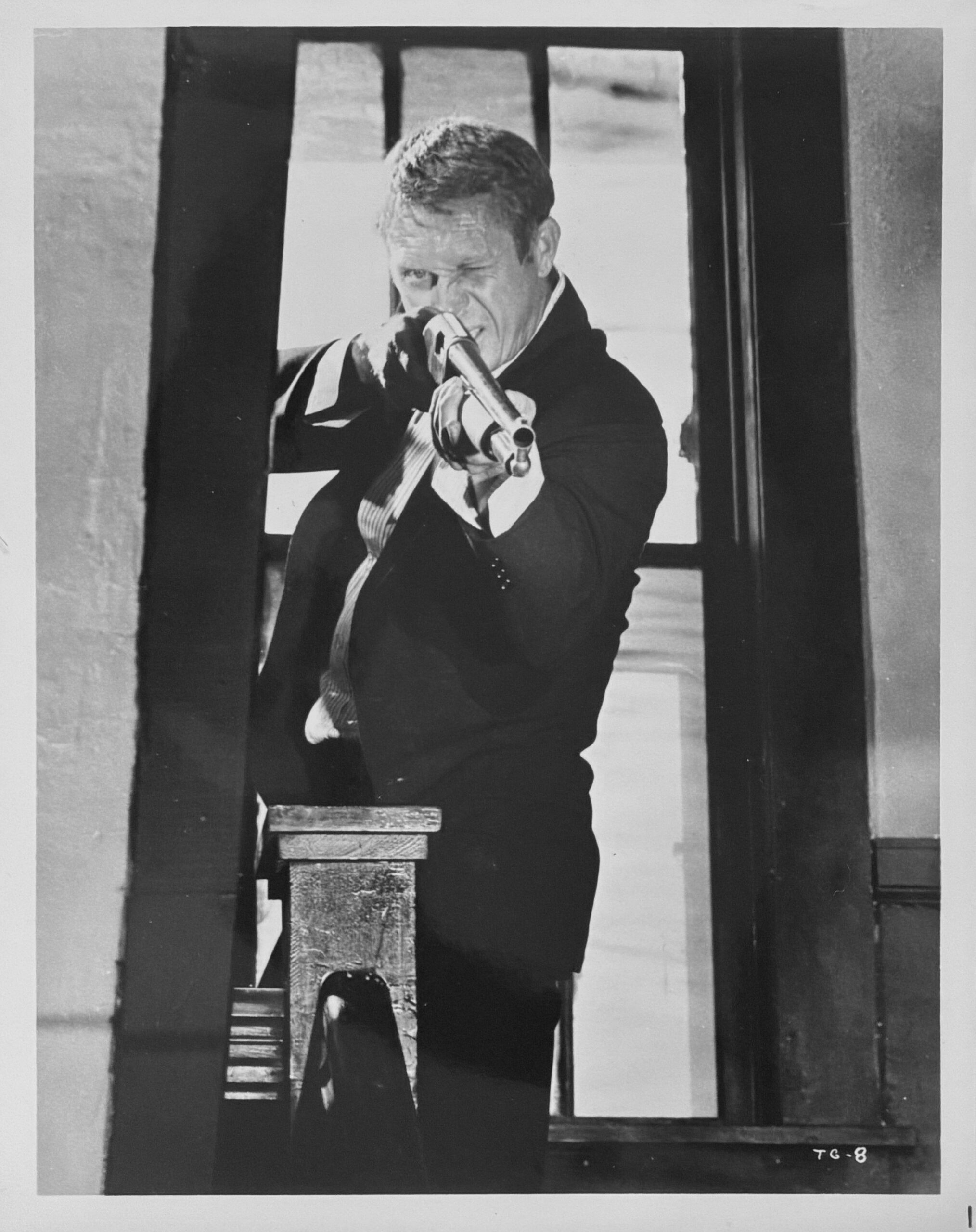
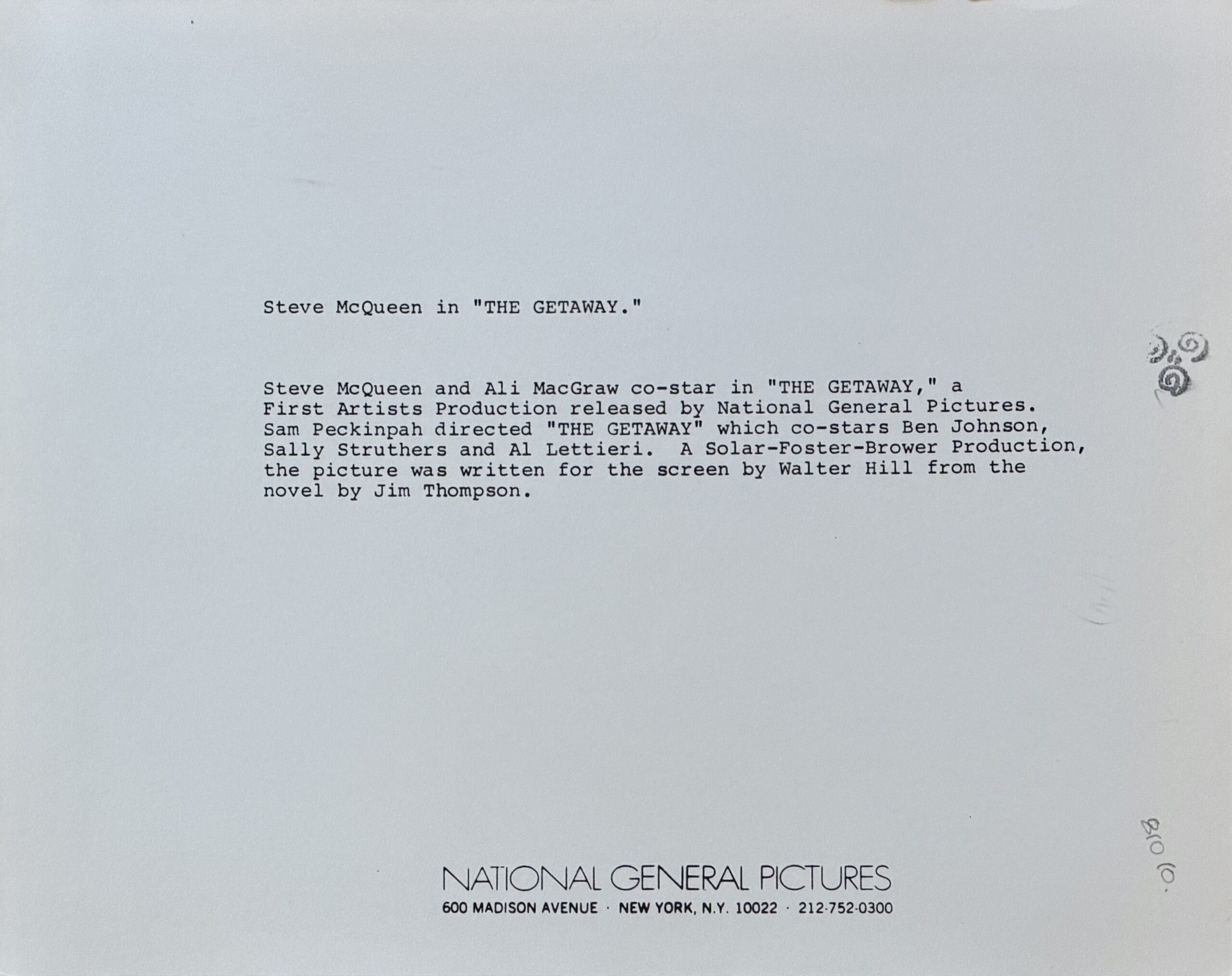
An original 1972 black and white promotional still for Sam Peckinpah’s “The Getaway”, a movie that delivers the three “S’s” – Style, Substance & Steve McQueen. When originally released in 1972 it set the template for gritty, realistic crime thrillers and redefined McQueen’s stylish look for the 1970s. A great looking image as McQueen is featured in full shotgun action, shoot out mode on this eye catching example. Originally flat and folded (as issued) it displays and presents superbly with the movie details printed on the reverse. This is an excellent, original, unrestored example for a rare & sought after Steve McQueen title.
Trivia: Colin Farrell, Kevin Costner, Pierce Brosnan and Bruce Willis have all listed McQueen as their hero and inspiration for being an actor.
…more detailVintage Movie Posters Grading Criteria... read more +
The Getaway Movie Poster
“Carter “Doc” McCoy is a career robber, currently in his fourth year of a 10-year prison sentence at the Texas State Penitentiary. After his request for parole is denied although he’s a model prisoner, Doc, unable emotionally to endure life inside, asks his loving wife Carol McCoy to contact crooked businessman Jack Beynon, a man with political connections, to secure his release in return for being “for sale” to Beynon. Beynon is able to get Doc released, the sale price being for Doc to plan and execute a robbery at a small bank branch in Beacon City, Texas where Beynon knows that $750,000 will be kept in the vault for the next two weeks. Rather than Doc using his own men for the job, Beynon directs that the only other people involved will be the men of his own choosing, Rudy and Frank. There are to be no casualties, which is all right with Doc who is not a murderer. After the robbery is completed and the monies divvied up accordingly, Doc and Carol will cross the border into Mexico to live out their lives away from capture. The robbery doesn’t go according to Doc’s plan, and Doc and Carol go on the run making their way into Mexico with their share of the loot. Various people are in their pursuit, some who know that they will try to cross into Mexico at one of the two major West Texas border crossings. Other bystanders get directly or indirectly involved in the proceedings; two of those people, seeming straight-laced couple Fran and Harold Clinton, get much more intimately involved than the others. Though it all, Doc and Carol must work through some of their own issues, which arise out of a revelation about Doc’s release from prison.”
When first released, Sam Peckinpah‘s “The Getaway“ was generally dismissed as a routine action movie, quite unworthy of its star and director. But that opinion of the film is totally wrong: this is far from routine fare. It’s a forceful, amoral, tightly editted, violent and nail-bitingly exciting thriller with coolness and style to burn. If anything, Peckinpah was crafting an action movie way ahead of its time; the critics – unsure of what to make of it – took the safe option and castigated it as an average potboiler.
Steve McQueen oozes an unnerving, charming aggression as Doc McCoy, a stolid ex-con who is no sooner out of jail than he is back to his criminal ways, robbing a bank with the help of his wife (Ali MacGraw). It would be a spoiler to reveal too many details of the robbery, but it’s enough to add that things go wrong and Mr and Mrs McCoy end up fleeing for Mexico, with a stash of cash and a whole bunch of gun-toting bad guys (as well as the cops) in hot pursuit.
The film is loosely structured, with the gun-toting couple stumbling from one blood-soaked adventure to the next, picaresque-style, as they attempt to reach the Mexican border. MacGraw looks a bit lost amid all this heavy-weight acting talent, but she gets away with it because she shares a lot of screen time with Steve McQueen…. and when he’s on screen, you tend not to notice her (so mesmerising is he that you just can’t take your eyes off him). Some of the gunfights are explosive and entertaining affairs, and the characters are brilliantly realised. Peckinpah has a good eye for graphic detail, but he also captures the barren wastelands of Texas with the kind of loving grace that you would usually expect from a landscape painter. “The Getaway” is a cracking ’70s thriller, well worth re-visiting.

Trade Address:
Vintage Movie Posters (UK) Limited
The Malthouse
The Broadway
Old Amersham
HP7 0HL


© 2026 Vintage Movie Posters
Registered Office Address: Vintage Movie Posters (UK) Limited, Aston House, Cornwall Avenue, London N3 1LF GB
Registered Company No: 07664517
Mint
A poster that has never been used or displayed and may show the most minor signs of age and wear. The poster should have no holes or tears.
Near Mint
A generally unused poster with fresh, saturated colors. May have minimal tears at folds. Has no significant holes, no paper loss, may have minor tears along edges, may have fine pin holes.
Very Fine
A poster with bright colour and crisp overall appearance. It may have very general signs of use including slight fold separation and fold wear. It may have pin holes or very minor tears. This is the highest grade allowed for a poster that has been restored either on linen or on paper.
Fine
A poster with good colors and overall clean appearance. It may have minor tears small paper loss and minor stains. It may have some fold seperation.
Good
An average poster with overall fresh color. May have tears, minor paper loss, minor hazing. Paper may be brittle due to age, may have minor stains. May have a small amount of writing in an unobtrusive place. May have medium or major restoration.
Fair
A poster with faded colors and brittle paper, showing significant signs of use. May have tears and paper loss. May have tape, writing, stains in image area. In need of restoration or had major restoration.
Poor
A poster that is worn, torn, and/or damaged. May have staining, cracking, dry rot, and/or large tears. May be heavily soiled, may have pieces missing. In need of major restoration.
All photographs and images used on our site are photographs of the actual poster/item you are buying, we do not use stock photographs.
LOBBY CARD
11 x 14″ printed on heavy stock paper. Used as display in theatre lobbies. Originally made in sets of eight. Some sets have a title card, which contains credits and artwork, essentially a mini-poster. The remaining seven cards are coloured photographic credits and poster artwork showing different scenes from the movie.
WINDOW CARD
14 x 22″ printed on heavy stock paper with the top 4-6 inches usually left blank for the local cinema owner to fill in the cinema and the date it was due to play. Largely discontinued during the 1970’s.
HALF SHEET
22 x 28″ printed on heavy stock paper. The image displayed is normally a smaller version of the main poster, although some do have different artworks and sometimes come in two versions.
INSERT
14 x 36″ printed on heavy stock paper. Inserts usually have the same artwork as a one sheet. Popular with collectors since they are smaller and easier to frame. Normally come tri folded or rolled.
STYLE Y/FORTY BY SIXTY
40 x 60″ printed on heavy stock paper. Rare since they were primarily used for major motion pictures only. Designed to be used outside the theatre, on an easel, normally at a drive-in movie theatre.
ONE-SHEET
27 x 41″ printed on paper. This is the most common size of poster, intended to be displayed in a glass “marquee” case. It is the most sought after size by collectors. Since the 1980’s most posters are sent to the theatre rolled and maybe slightly smaller measuring 27″ by 40″ and with the advent of backlit light boxes a growing number of modern movie posters are available double-sided and the more traditional single-sided.
THREE-SHEET
41 x 81″ printed on paper. These were printed on two or three separate sheets designed to overlap, few survive. Used for larger advertising spaces, normally posted on walls, perfect for huge movie theatres the drive-in, where people could see them from a distance. From the 1970’s on, three-sheets were sometimes printed in one piece and issued as “international” versions to be used abroad.
BRITISH QUAD
30 x 40″ Most common poster size used in the UK. British Quads are horizontal and may have different artwork to the US one sheet. Like a US one sheet they normally come in two versions. Like a US one sheet they are usually supplied single-sided or more commonly now as a double sided poster.
BRITISH ONE-SHEET
27 X 40″, printed on paper. Very rarely used size.
ITALIAN LOCANDINA
13 x 28″ six inches shorter than the US insert, very nice size to frame. Italian poster illustrators are some of the best in the industry.
ITALIAN PHOTOBUSTA
18 x 26″ Glossy, high quality, used as lobby cards in Italy. Size may vary, either vertical or horizontal format. There are also double Photobusta or mini Photobusta.
2-FOGLIO (DUE)
(DUE): 39 x 55″ This is the standard poster size used in Italy. Italian poster illustrators are some of the best in the industry.
4-FOGLIO
(QUATTRO) 55 x 79″ Very large Italian poster printed in two pieces, often contains very beautiful artwork.
FRENCH
47 x 63″ (GRANDE) or 24 x 33″ (PETITE) French movie posters normally come with different artwork to either the US or the UK. Like the Italian’s some of the artwork is extrememly beautiful.