£125.00
Film
The Doors: When You’re Strange
Near mint minus; originally rolled (as issued)
Tom DiCillo
Janis Joplin, Jim Morrison,, Jimi Hendrix, John Densmore, Johnny Depp, Pamela Courson, Ray Manzarek, Robby Krieger, The Doors
2025
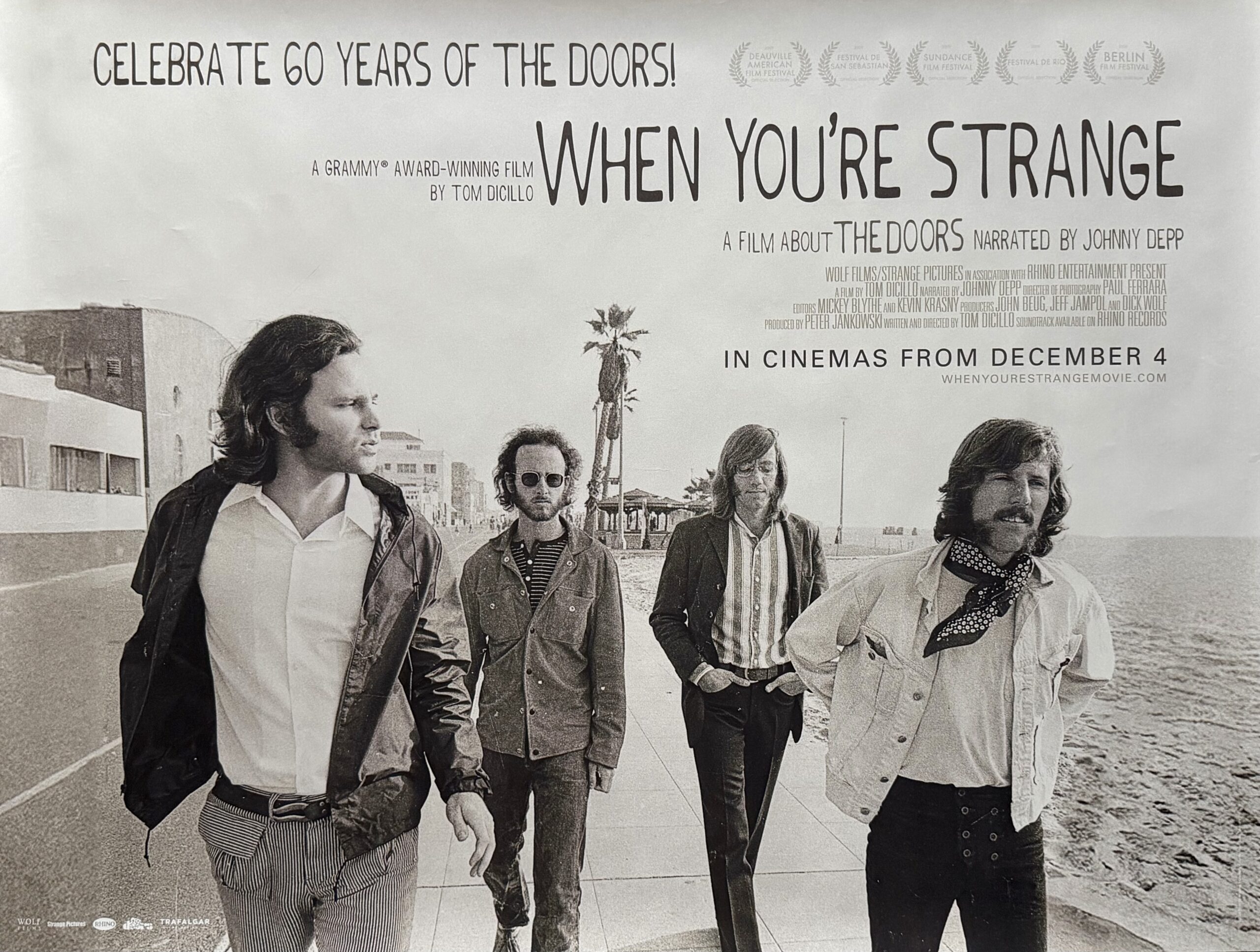
UK Quad (30" x 40") Double Sided
SOLD - this item is sold. Please browse our currently available stock
Original British UK quad film poster for Tom DiCillo’s The Doors rockumentary “When You’re Strange”. In celebration of the 60th anniversary of The Doors, this documentary is remastered in 4K for the first time for the 2010 release and follows the band through their career from their formation in 1965 to Jim Morrison’s death in 1971. Produced with the full co-operation of the remaining members of the band and includes some incredible previously unreleased and unseen footage from their formation in 1965 to Jim Morrison’s death, news clips, and narration by Johnny Depp, the documentary follows the band through their career, providing insight into the revolutionary impact of their music and features a newly recorded performance of one their most iconic sings – ‘Riders on the Storm’. . Featuring band imagery from a Joel Brodsky photograph it is a poster design that’s perfectly suited to the landscape format go the British quad. From 2010, this originally rolled (as issued), example is presented in excellent high grade condition. Fantastic The Doors and cinema collectable and a great looking piece of music and film memorabilia.
Trivia: Director Tom DiCillio said critics frequently complained about the use of “recreated scenes and body doubles.” The scenes referred to are, in fact, authentic but rarely seen footage of Jim Morrison taken from the film negative for Morrison’s film HWY.
…more detailVintage Movie Posters Grading Criteria... read more +
“A chronological look at The Doors, focusing on lead singer, Jim Morrison (1943-1971), from the formation of the band in 1965, it’s first gigs, and first album, to Morrison’s death, after years of alcohol and drug use. Along the journey, we see archival footage of rehearsals, performances, and private moments including a Miami concert resulting in Morrison’s arrest and trial for indecency. His love of the spotlight, his desire to be a poet, and his alcohol-fueled mood swings lead to a back and forth between public and private desires, successes, and failures. The band’s music plays throughout”
For “When You’re Strange”, writer/director Tom DiCillo was able to gain access to original footage shot from 1966-71 by Paul Ferrara, a UCLA Film School buddy of flamboyant lead singer Jim Morrison. Those old, grainy films are all that were needed to make this stunning documentary, no modern-day or additional footage was shot.
The dramatic voice-over was provided by Johnny Depp who, in a statement from Tom DiCillo read prior to the screening, was the one person the filmmakers felt qualified to narrate the movie. It had to be someone with a passion for the music of The Doors, and Depp fit the bill.
With the assistance of the remaining living members, particularly band co-founder and keyboardist Ray Manzarek, the film is destined to be the definitive chronicle of the band’s history. We finally discover the shocking truth behind the curious myths, did Morrison really expose his genitals at that infamous Florida concert? Did he fake his own death? “When You’re Strange” separates fact from fiction and puts to rest the many rumours surrounding the manic life and untimely death of Jim Morrison. The heretofore secret details behind the making of each amazing album (one took 11 months, another took less than a week) are mind-boggling. Naturally, there’s plenty of music. Tons of it.
Like all music docs, the degree to which one connects with the film is directly proportional to one’s familiarity with the music and/or artists featured in the production. This certainly applies here. Like some of the thrilling music documentaries I’ve seen at festivals in the past couple of years (“The U.S. vs. John Lennon,” “Dixie Chicks: Shut Up and Sing,” “The Wrecking Crew,” “Kurt Cobain About a Son”), I put “When You’re Strange” right at the top of my list. I was blown away. However, while I walked away feeling that this was an absolutely brilliant film, I have to give it a qualified thumbs up if only because there is no doubt many simply won’t have the emotional response that I did. But, for fans of this music, “When You’re Strange” is absolutely a must-see.

Trade Address:
Vintage Movie Posters (UK) Limited
The Malthouse
The Broadway
Old Amersham
HP7 0HL


© 2026 Vintage Movie Posters
Registered Office Address: Vintage Movie Posters (UK) Limited, Aston House, Cornwall Avenue, London N3 1LF GB
Registered Company No: 07664517
Mint
A poster that has never been used or displayed and may show the most minor signs of age and wear. The poster should have no holes or tears.
Near Mint
A generally unused poster with fresh, saturated colors. May have minimal tears at folds. Has no significant holes, no paper loss, may have minor tears along edges, may have fine pin holes.
Very Fine
A poster with bright colour and crisp overall appearance. It may have very general signs of use including slight fold separation and fold wear. It may have pin holes or very minor tears. This is the highest grade allowed for a poster that has been restored either on linen or on paper.
Fine
A poster with good colors and overall clean appearance. It may have minor tears small paper loss and minor stains. It may have some fold seperation.
Good
An average poster with overall fresh color. May have tears, minor paper loss, minor hazing. Paper may be brittle due to age, may have minor stains. May have a small amount of writing in an unobtrusive place. May have medium or major restoration.
Fair
A poster with faded colors and brittle paper, showing significant signs of use. May have tears and paper loss. May have tape, writing, stains in image area. In need of restoration or had major restoration.
Poor
A poster that is worn, torn, and/or damaged. May have staining, cracking, dry rot, and/or large tears. May be heavily soiled, may have pieces missing. In need of major restoration.
All photographs and images used on our site are photographs of the actual poster/item you are buying, we do not use stock photographs.
LOBBY CARD
11 x 14″ printed on heavy stock paper. Used as display in theatre lobbies. Originally made in sets of eight. Some sets have a title card, which contains credits and artwork, essentially a mini-poster. The remaining seven cards are coloured photographic credits and poster artwork showing different scenes from the movie.
WINDOW CARD
14 x 22″ printed on heavy stock paper with the top 4-6 inches usually left blank for the local cinema owner to fill in the cinema and the date it was due to play. Largely discontinued during the 1970’s.
HALF SHEET
22 x 28″ printed on heavy stock paper. The image displayed is normally a smaller version of the main poster, although some do have different artworks and sometimes come in two versions.
INSERT
14 x 36″ printed on heavy stock paper. Inserts usually have the same artwork as a one sheet. Popular with collectors since they are smaller and easier to frame. Normally come tri folded or rolled.
STYLE Y/FORTY BY SIXTY
40 x 60″ printed on heavy stock paper. Rare since they were primarily used for major motion pictures only. Designed to be used outside the theatre, on an easel, normally at a drive-in movie theatre.
ONE-SHEET
27 x 41″ printed on paper. This is the most common size of poster, intended to be displayed in a glass “marquee” case. It is the most sought after size by collectors. Since the 1980’s most posters are sent to the theatre rolled and maybe slightly smaller measuring 27″ by 40″ and with the advent of backlit light boxes a growing number of modern movie posters are available double-sided and the more traditional single-sided.
THREE-SHEET
41 x 81″ printed on paper. These were printed on two or three separate sheets designed to overlap, few survive. Used for larger advertising spaces, normally posted on walls, perfect for huge movie theatres the drive-in, where people could see them from a distance. From the 1970’s on, three-sheets were sometimes printed in one piece and issued as “international” versions to be used abroad.
BRITISH QUAD
30 x 40″ Most common poster size used in the UK. British Quads are horizontal and may have different artwork to the US one sheet. Like a US one sheet they normally come in two versions. Like a US one sheet they are usually supplied single-sided or more commonly now as a double sided poster.
BRITISH ONE-SHEET
27 X 40″, printed on paper. Very rarely used size.
ITALIAN LOCANDINA
13 x 28″ six inches shorter than the US insert, very nice size to frame. Italian poster illustrators are some of the best in the industry.
ITALIAN PHOTOBUSTA
18 x 26″ Glossy, high quality, used as lobby cards in Italy. Size may vary, either vertical or horizontal format. There are also double Photobusta or mini Photobusta.
2-FOGLIO (DUE)
(DUE): 39 x 55″ This is the standard poster size used in Italy. Italian poster illustrators are some of the best in the industry.
4-FOGLIO
(QUATTRO) 55 x 79″ Very large Italian poster printed in two pieces, often contains very beautiful artwork.
FRENCH
47 x 63″ (GRANDE) or 24 x 33″ (PETITE) French movie posters normally come with different artwork to either the US or the UK. Like the Italian’s some of the artwork is extrememly beautiful.